If you are clearing a facility with switchgear marked above 4,000 A and 27.6 kV, a useful review begins with exact identification and a clear account of what remains together. These high-capacity assemblies are configuration-specific: bus ratings, breaker details, section arrangement, and completeness all affect assessment. Share what can be documented safely, and Louisiana Switchgear Buyer can review the equipment before deciding whether to make an offer.
Capture ratings exactly as marked
Photograph each accessible nameplate and transcribe its wording, including units, decimals, voltage designation, and any listed frequency or phase. For a 27.6 kV assembly, record the marked voltage rather than describing it only by the facility’s nominal system voltage or assumed application. Likewise, preserve the exact current marking instead of reducing it to “over 4,000 A.” Include the manufacturer and catalog or type designation when legible. Do not open an energized compartment or remove covers to locate a label. If information is obscured or inaccessible, note that limitation; a qualified professional can address access as part of authorized work.
Separate bus, breaker, and interruption data
A large current figure can refer to different parts or ratings of an assembly. Identify whether the marking applies to the main bus, a breaker frame, or another component, and keep continuous-current information distinct from interrupting ratings. Do not treat a breaker’s frame size as proof of the bus rating, or infer fault-interruption capability from a current value alone. Record each device’s visible nameplate data separately where safely available. If the distinction is unclear, send photographs and flag the uncertainty for technical review rather than assigning a rating yourself. These details help prevent unlike configurations from being compared as equivalent.
Describe the complete lineup
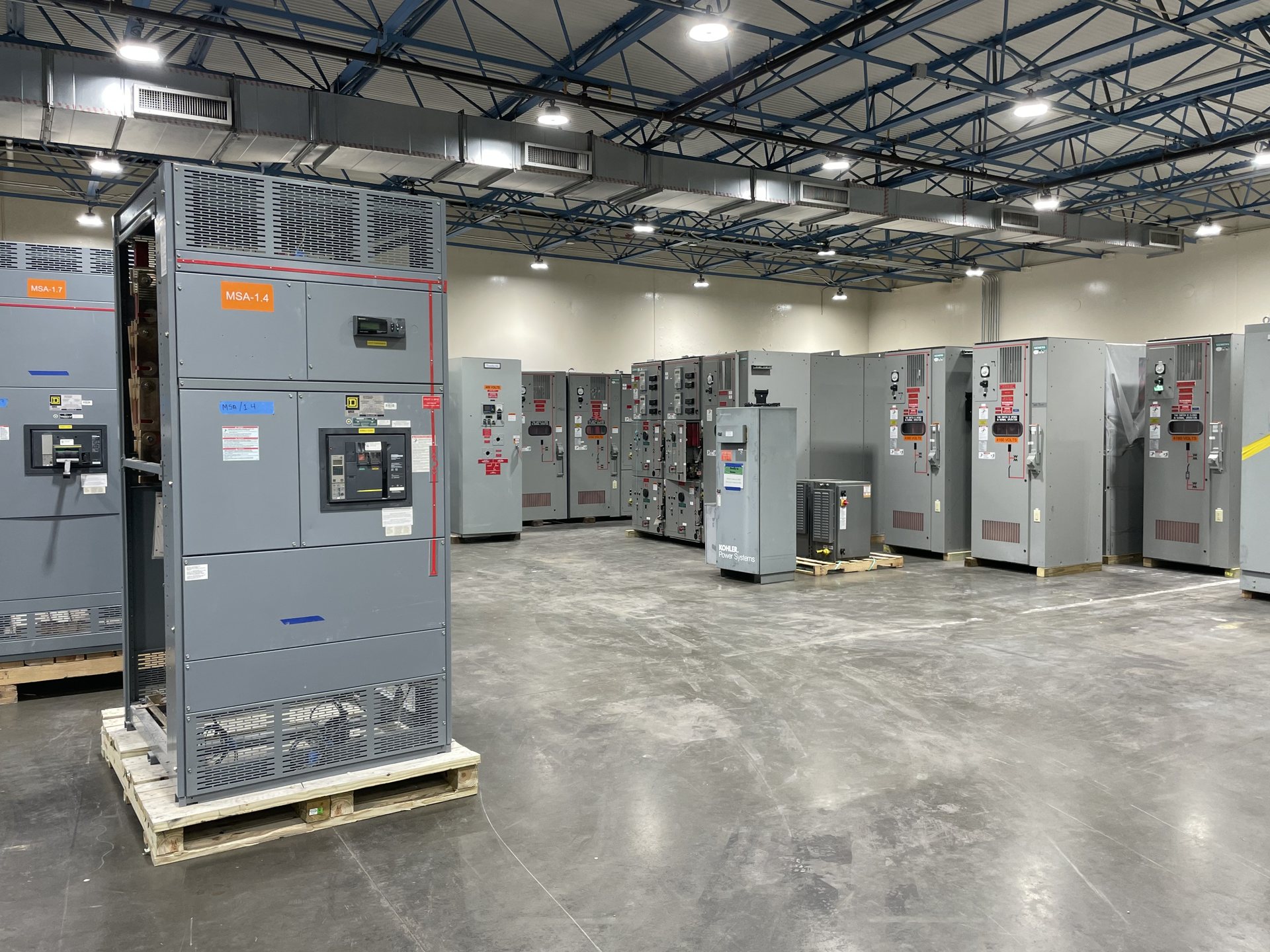
Report the number of sections and the overall arrangement, including any lineup extensions, transitions, or separated pieces that belong to the same installation. Provide approximate dimensions and enclosure information if available, and identify whether the equipment is indoor or outdoor only when that is plainly documented or known. List the visible devices, such as breakers or switches, by position and marked identification where possible. Note whether doors, panels, barriers, and other expected components appear present, missing, or detached. A section count and device list help show what is included; they do not establish that equipment is operational or complete internally.
Make completeness visible in the record
A review is more useful when the inventory distinguishes installed equipment from loose or separately stored parts. Note which breakers, control components, relays, bus connections, covers, and accessories remain with the lineup, without handling electrical parts to check them. Identify any known removals or substitutions and describe visible damage, corrosion, contamination, or missing items factually. Photographs of the lineup exterior, section labels, and loose equipment can support the written list. Avoid describing the assembly as tested or ready for service unless that status is supported by appropriate records; seller testing is not required for an initial purchase assessment.
Record condition without creating exposure
Use observations available from safe, authorized access: exterior condition, visible impact damage, enclosure state, and whether components appear present. Do not touch conductors, operate mechanisms, open energized compartments, or attempt electrical isolation for photographs. If the equipment is behind controlled access or remains connected, say so and explain what information cannot be reached. Work involving electrical isolation, lifting, rigging, or removal must be handled by qualified professionals. Louisiana Switchgear Buyer coordinates and pays for qualified disconnects and removal, including rigging, crane work, loading, freight, and hauling when a transaction is agreed.
Share access and removal constraints
Along with the equipment record, explain where the lineup is located within the facility, how it is accessed, and any known restrictions on removal or loading. Useful details may include doorway or route dimensions, overhead clearance, stairs, adjacent equipment, and whether sections are already separated, provided these can be reported without entering a hazardous area or measuring near energized gear. Clarify whether the equipment is decommissioned, still connected, or of uncertain status. Leave all electrical work, lifting plans, and rigging decisions to qualified professionals; do not dismantle or move sections to make them easier to assess.
Submit the record for assessment
Send the marked ratings, manufacturer and catalog information, section count, enclosure, dimensions, device list, visible condition, completeness notes, and photographs together where practical. Include uncertainties rather than filling gaps with estimates, especially around the 27.6 kV marking and the over-4,000 A rating. The equipment is assessed before an offer, and acceptance is not guaranteed. If the transaction is agreed, payment is made upfront and the buyer handles the removal and associated logistics. This process applies to surplus or decommissioned switchgear from industrial facilities, data centers, and shut-down power plants as well as other sources.
Buyer notes
Send the facts that move the review forward.
Include the nameplate, lineup or device photos, approximate quantity, visible condition and where the equipment is located. We buy equipment; we do not sell replacement gear or represent a test result that has not been provided.
Start with the nameplate
Request a quote
Tell us what you have. We buy switchgear from decommissioned data centers, shut-down power plants and other facilities. Crane, rigging, disconnects, loading, freight and hauling are on us. You do nothing but get paid.