When a data center is decommissioned, redundancy diagrams and process records can help explain why electrical equipment was installed and how assemblies relate. They do not, by themselves, establish what remains in a sale lot or its present condition. A useful review distinguishes complete equipment from loose devices, records visible identification, and notes unknowns and access constraints before Louisiana Switchgear Buyer assesses the equipment for a possible purchase.
Use redundancy records as context, not proof of completeness
A one-line diagram or section schedule may show parallel paths, standby feeds, or equipment assigned to particular loads. That context can help organize a review of switchboards, automatic transfer switches (ATSs), busway, power distribution units (PDUs), breakers, and related assemblies. Compare available records with what is physically included, but do not assume a depicted item is still present or that a former redundant arrangement remains intact. Record differences plainly: a section listed on a schedule but not observed, a device shown in a lineup but staged separately, or an identifier that does not match the document. These distinctions are more useful than inferring function from the former facility’s design.
Separate complete assemblies from loose components
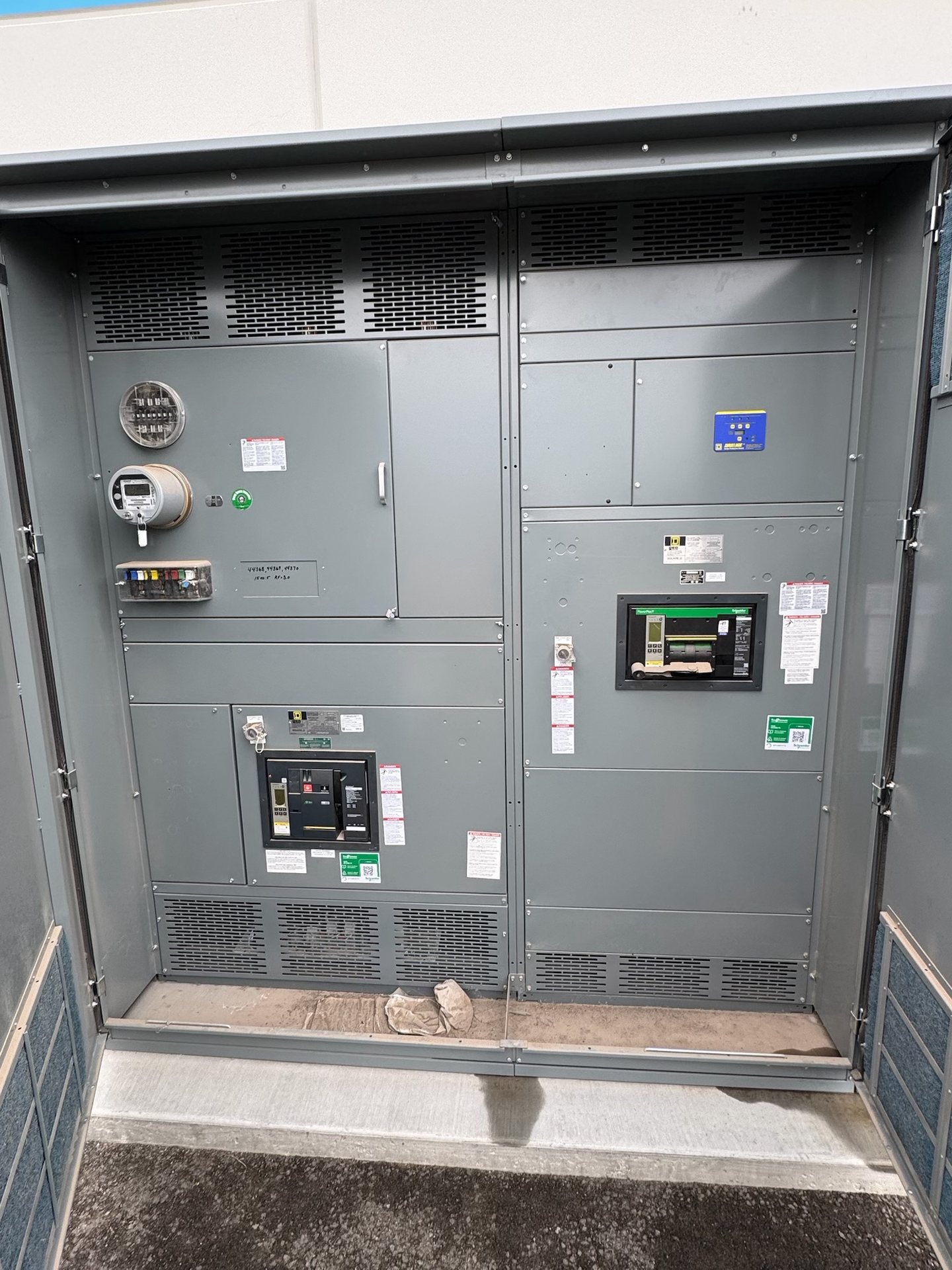
For each lot, identify which items appear to be complete assemblies and which are loose devices or accessories. A switchboard section may be offered with its enclosure and installed equipment, while breakers, trip units, control components, or mounting parts may be separate. An ATS should be distinguished from associated bypass or distribution equipment rather than grouped by assumed function. Likewise, list busway sections, fittings, and supports separately when their inclusion is uncertain. Use neutral descriptions such as “assembly with visible components” or “loose breaker, rating to be confirmed.” Do not represent an assembly as complete solely because a drawing shows a full lineup or because the equipment once served a redundant path.
Capture visible identifiers and ratings consistently
Record information that can be read from accessible nameplates, labels, and markings, including manufacturer, model or catalog number, serial number, voltage, current rating, and interrupting or short-circuit rating when stated. Note the equipment type and section or device identifier as marked. Photograph the overall assembly and readable labels from safe, accessible positions; include enough context to connect each close-up to the relevant item. Do not open energized compartments or handle electrical devices to find hidden markings. If a label is obscured, missing, or unreadable, enter “not visible” or “unknown” rather than deriving a rating from a neighboring section, old schedule, or apparent application.
Keep device lists tied to the physical lot
A device list is most useful when each entry can be matched to an assembly or clearly identified loose item. Include quantity, visible designation, rating information that is actually marked, and whether the device is installed or staged separately. For grouped breakers or accessories, note the storage location only when it can be stated reliably and safely. Redundancy labels such as A-side, B-side, primary, or reserve may help explain the original process context, but they are not substitutes for equipment identification. Preserve those labels as recorded observations and distinguish them from confirmed device data. Flag count differences between a schedule and the visible lot for review rather than silently reconciling them.
Document the limits of what is known
A clear review says what remains uncertain. That may include missing schedules, incomplete assemblies, unreadable nameplates, unknown accessory compatibility, unverified quantities, or uncertainty about whether separate devices belong with a particular lineup. Mark each point specifically so it can be considered during assessment. Do not describe used or decommissioned equipment as operational, tested, or ready for reuse unless that status has been established independently. Seller testing is not required for an offer review. Photographs and records can support an equipment assessment, but they do not replace inspection or confirm the condition of internal components. Louisiana Switchgear Buyer assesses the equipment before making an offer; acceptance is not guaranteed.
Record dimensions and access conditions separately
Provide approximate dimensions for assemblies or sections when they are known, and identify whether measurements cover one section, a connected lineup, or a loose item. Note practical access information: where the equipment is staged, visible approach limitations, loading-area constraints, and any known restrictions on scheduling or removal. Do not disconnect, move, lift, or dismantle equipment to obtain measurements or improve access. Electrical isolation, qualified disconnects, rigging, lifting, loading, and hauling must be handled by qualified professionals. Louisiana Switchgear Buyer handles and pays for removal logistics on an agreed transaction, including qualified disconnects, crane and rigging, loading, freight, and hauling. Accurate access notes help the parties consider the work involved.
Confirm authority and assemble a review package
Before sending records, identify the seller and document ownership or authorization status, including who is permitted to approve a sale and arrange access. Gather available one-line diagrams or section schedules, nameplate and overview photos, a device list, dimensions, access notes, and a concise list of known unknowns. Keep records tied to the lot being offered; data-center documentation can cover equipment that is no longer present or belongs to a different area. The buyer can review the information alongside the equipment description and assess whether to make a cash offer. If terms are agreed and accepted, payment is made upfront. The seller does not need to perform testing or removal work.
Move from documentation to an equipment assessment
Submit the package as a factual account of what is included, what is separately staged, what markings are visible, and what remains unresolved. The redundancy or process context can help explain the arrangement, but the purchase review centers on the actual equipment and its identified scope. Include switchboards, ATS units, busway, PDUs, breakers, and related distribution assemblies where applicable, without assuming every item will be accepted. The buyer purchases used, surplus, and decommissioned electrical equipment across voltage classes, including gear from decommissioned data centers. After assessing the equipment, Louisiana Switchgear Buyer may make an offer. Any removal plan follows only after the transaction is agreed, with handling managed by qualified professionals.
Buyer notes
Send the facts that move the review forward.
Include the nameplate, lineup or device photos, approximate quantity, visible condition and where the equipment is located. We buy equipment; we do not sell replacement gear or represent a test result that has not been provided.
Start with the nameplate
Request a quote
Tell us what you have. We buy switchgear from decommissioned data centers, shut-down power plants and other facilities. Crane, rigging, disconnects, loading, freight and hauling are on us. You do nothing but get paid.