If you have switchgear marked 100–225 A and 480Y/277 V, record each rating in its nameplate context before requesting a review. That range can describe different parts of an assembly, and it does not by itself establish the main rating, bus capacity, breaker performance, or suitability for a particular system. Louisiana Switchgear Buyer purchases used, surplus, and decommissioned equipment, subject to assessment and an offer you may accept or decline.
Start with the complete nameplate
Provide clear photographs of the equipment identification and rating labels, along with a written transcription where the markings are legible. Capture the manufacturer, catalog or model number, exact voltage notation, amperage, phase, frequency, and any other marked ratings. Preserve symbols and suffixes rather than converting them into a general description. A label stating 480Y/277 V is more informative than “480 volt,” but it still needs to be considered with the equipment’s other markings. Do not remove covers or approach exposed electrical parts to obtain a photo. If labels are inaccessible, have qualified personnel determine whether safe documentation is possible.
Separate the main, bus, and device ratings
Within the 100–225 A range, identify which component each amperage belongs to. The main device rating, bus rating, and individual breaker ratings are not interchangeable; a panel or section may include multiple values. Record each one as marked and describe its location in the assembly when that can be done safely. If the nameplate gives a bus rating while a breaker has a different frame or trip marking, report both instead of selecting one as the overall rating. This distinction helps an assessment describe what is present without assuming that one number characterizes every part of the equipment.
Keep voltage and interruption data distinct
Record the marked system voltage separately from breaker interrupting information. A breaker frame rating or continuous current rating does not state its interrupting rating, and an interrupting value is not the assembly’s bus capacity. Likewise, do not infer the system connection or intended application solely from a 480Y/277 V marking. Include any separately marked phase and frequency, and note when a field is unreadable or absent. These details help distinguish electrical identification from assumptions about prior use. Do not energize equipment or conduct testing for the review; no seller testing is required to submit the information.
Describe sections and enclosure
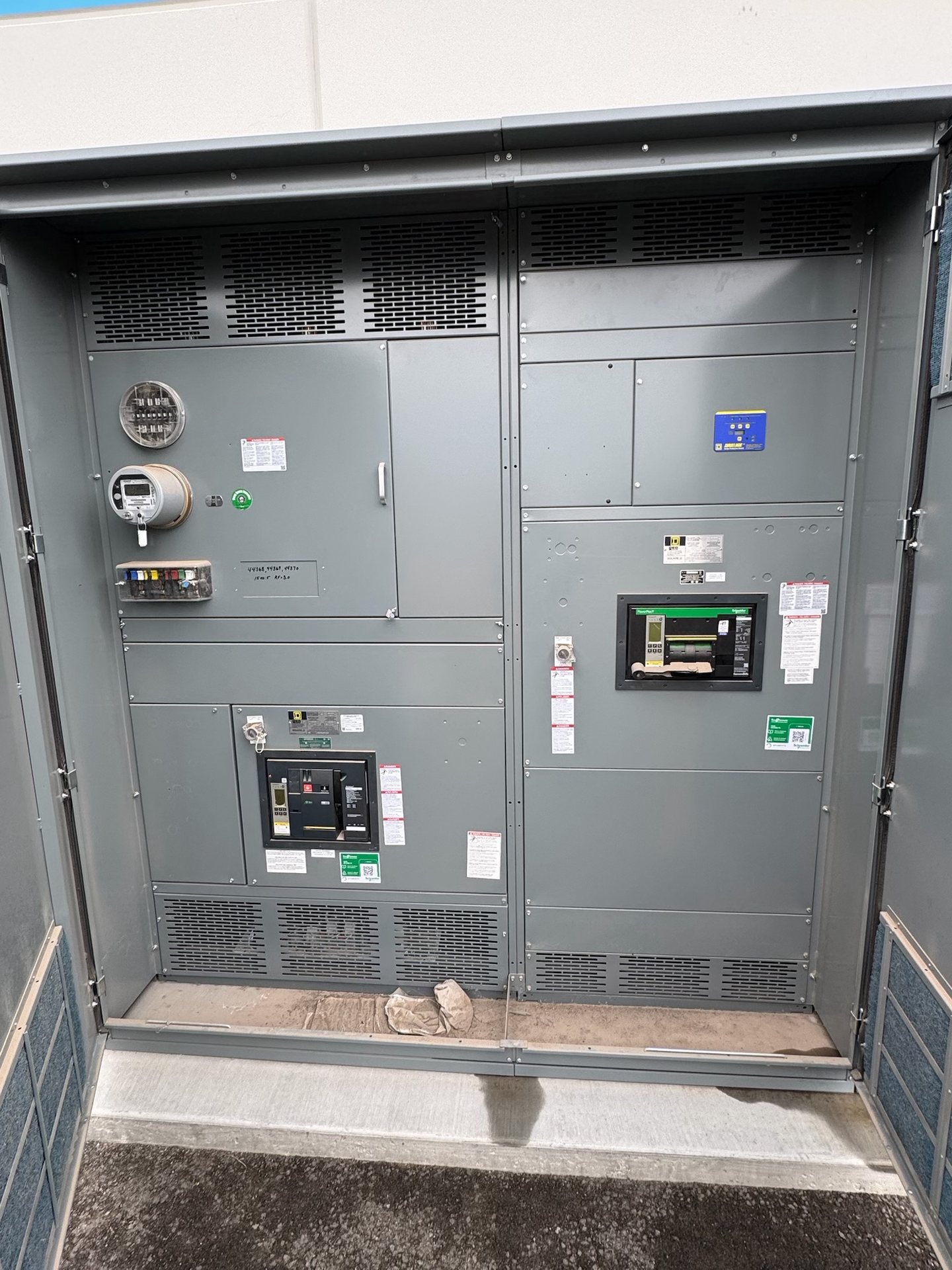
Report how many sections are included and whether they appear to belong together, using the existing arrangement as your reference. Note enclosure style or type only when it is identified or readily visible, and provide overall dimensions if they can be measured without moving, opening, or disturbing the gear. Mention whether doors, covers, barriers, trim, and other visible parts appear present, missing, or damaged. A compact panelboard and a larger multi-section assembly can share voltage and current markings while differing substantially in scope. Photographs showing the full exterior and section layout help reviewers understand what the listed ratings apply to.
List breakers and other included devices
Make a device list from accessible labels and visible information: include breaker quantities, marked ratings, catalog identifiers, and apparent positions where readable. Identify any separately included components or accessories, and distinguish installed devices from loose items. If a breaker label cannot be read, say so rather than estimating its rating. Note whether sections appear incomplete or whether devices have been removed, but do not operate handles, remove deadfronts, or open compartments to check. An accurate inventory supports an informed assessment of completeness and keeps the review grounded in what can be documented without electrical work.
Report visible condition without testing
Describe condition in observable terms, such as missing exterior parts, dents, corrosion, broken handles, or visible shipping damage. Avoid conclusions such as “fully operational” or “tested” unless a separate, documented basis exists; a photograph cannot establish electrical condition. Do not clean, repair, energize, disconnect, or reposition equipment for documentation. If the assembly is already isolated or decommissioned, report that status only if known, and do not treat it as proof of condition. Used, surplus, and decommissioned gear can be reviewed without seller testing, but the equipment is assessed before any offer is made.
Plan access and removal with qualified crews
Tell us where the assembly is situated within the facility and note practical access constraints, such as restricted routes, limited clearance, stairs, overhead obstructions, or other equipment nearby. Share known dimensions and any site requirements relevant to arranging removal. Do not disconnect wiring, lift, rig, or prepare the equipment yourself. Electrical isolation, qualified disconnection, crane or rigging work, loading, freight, and hauling are handled by us and paid for on agreed transactions. Work involving electricity or lifting must be performed by qualified professionals; keep people clear of the equipment until the appropriate removal arrangements are made.
Send the record for assessment
Submit the ratings, section count, dimensions, enclosure description, device list, completeness notes, visible condition, and photographs together so the review has a coherent picture of the assembly. Include any uncertainty explicitly, especially where labels are missing or multiple ratings could be confused. We assess the equipment before making an offer; acceptance is not guaranteed. If terms are agreed and you accept, payment is made upfront, and removal logistics are arranged with qualified personnel. Louisiana Switchgear Buyer purchases equipment across voltage classes, including switchgear from decommissioned data centers and shut-down power plants.
Buyer notes
Send the facts that move the review forward.
Include the nameplate, lineup or device photos, approximate quantity, visible condition and where the equipment is located. We buy equipment; we do not sell replacement gear or represent a test result that has not been provided.
Start with the nameplate
Request a quote
Tell us what you have. We buy switchgear from decommissioned data centers, shut-down power plants and other facilities. Crane, rigging, disconnects, loading, freight and hauling are on us. You do nothing but get paid.