If you have under-100 A equipment marked 120/240 V, a careful record can help Louisiana Switchgear Buyer determine whether it fits a purchase review. These ratings alone do not identify the full assembly or establish how it was used. Share information already available in facility records, along with photographs taken safely from outside the equipment. We assess the details before making any offer; acceptance is not guaranteed.
Start with the complete nameplate context
Record every legible nameplate value exactly as shown, including voltage, amperage, manufacturer, catalog or model number, and any listed frequency or phase. Include the nameplate location on the assembly if visible from a safe exterior position. “Under 100 A” may describe a particular device or bus rating, not necessarily every part of the equipment. Likewise, 120/240 V is a marked voltage, not proof of a specific service arrangement. A clear transcription lets a buyer compare the markings with drawings, schedules, and other records without treating an incomplete label as a complete specification.
Separate bus, breaker frame, and continuous ratings
When records provide them, list the main bus rating separately from each breaker’s frame size and marked trip or continuous rating. These figures describe different aspects of an assembly and should not be collapsed into one amperage number. A breaker frame rating does not by itself establish its installed trip setting or the assembly’s bus capacity. Note whether a value comes from a nameplate, device label, panel schedule, or drawing, and flag any uncertainty. This distinction helps reviewers understand what the under-100 A description refers to and whether the available documentation supports a meaningful comparison.
Record interrupting ratings as their own values
Capture any marked interrupting rating, including its units and the voltage associated with that rating. Do not substitute a breaker’s frame rating or a system’s nominal voltage for interrupting capacity; they are separate characteristics. If the value is absent, unreadable, or available only in older records, say so rather than estimating it. Existing equipment schedules or specification sheets can be useful supporting material, but identify their source and whether they refer to this exact assembly. For buyer review, clearly separated values make it easier to identify what is documented and what still requires confirmation.
Describe phase, poles, and system configuration
For equipment marked 120/240 V, provide the phase and pole information shown on its labels or in facility records. Include the documented system configuration when available, rather than assuming one from the voltage marking. Note whether pole counts refer to the main device, branch devices, or another component. A photograph taken from outside may show labels or a device directory, but do not open compartments or approach exposed electrical parts to obtain it. The distinction between marked voltage and assumed use helps a reviewer assess whether the assembly’s documented configuration aligns with the stated application.
Inventory sections, enclosure, and dimensions
Report the number of sections, enclosure type or marking, and overall dimensions if these details are already recorded or can be measured without moving or contacting the equipment. Include whether the assembly appears to be a single cabinet or multiple joined sections, based on records or a safe exterior view. Dimensions and section count help buyers consider handling, transport, and whether the listed devices belong to one assembly. Do not remove covers, disconnect equipment, or arrange lifting to improve access for photographs. Qualified professionals handle isolation, removal, rigging, loading, and hauling as part of an agreed transaction.
List devices and note completeness
Provide a device list from an existing schedule or directory, with manufacturer or catalog details and marked ratings where recorded. Identify known gaps, such as a missing panel directory, absent device, or incomplete section, without trying to verify conditions by opening equipment. If the assembly includes breakers or accessories stored separately, describe their documented relationship to it and photograph them only if they can be shown safely. Completeness matters because an apparently similar assembly may have different included devices or components. A precise inventory helps the buyer assess what is actually being offered, rather than relying on a broad label alone.
Use safe exterior photographs and condition notes
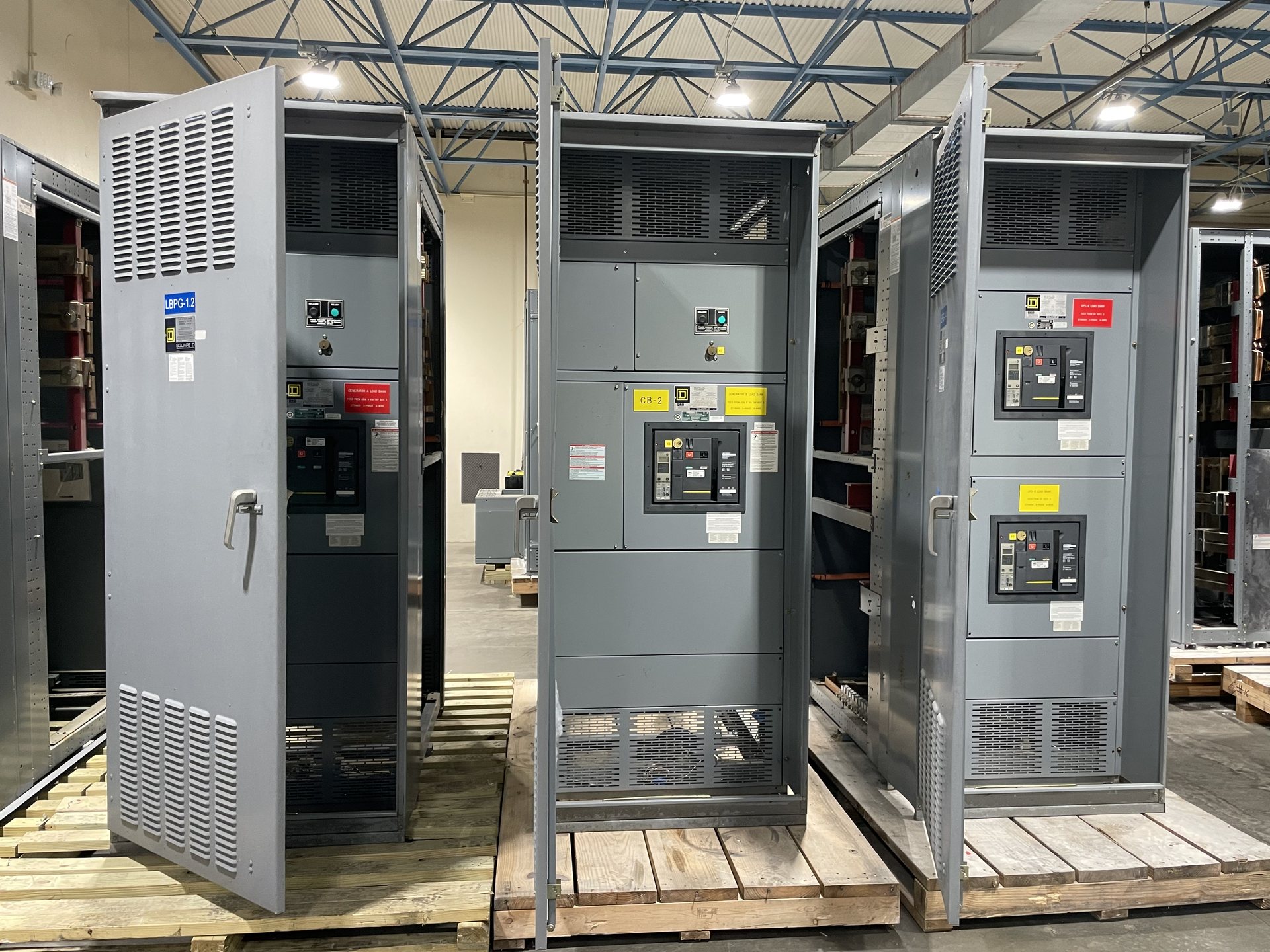
Take photos only from a safe position outside the equipment: overall views, visible nameplates, exterior labels, and any readily visible damage or corrosion can be useful. Do not open energized compartments, touch conductors, remove panels, or enter restricted areas for a better image. Describe visible condition plainly, distinguishing what can be seen from what is unknown internally. Note whether labels are legible and whether doors or covers appear present, without testing operation. Photographs supplement—not replace—ratings and records, and they do not establish that equipment is tested or operational.
Submit a review-ready record
A concise package can include exact marked ratings, manufacturer and catalog information, section count, enclosure, dimensions, device list, visible condition, completeness, and the source of each detail. Attach available drawings or schedules and label photographs so the reviewer can match them to the correct section. Louisiana Switchgear Buyer assesses the equipment and information before deciding whether to make an offer; acceptance is not guaranteed. If an agreed purchase proceeds, payment is made upfront, and the buyer handles and pays for qualified disconnects, crane and rigging, loading, freight, and hauling. No seller testing is required.
Buyer notes
Send the facts that move the review forward.
Include the nameplate, lineup or device photos, approximate quantity, visible condition and where the equipment is located. We buy equipment; we do not sell replacement gear or represent a test result that has not been provided.
Start with the nameplate
Request a quote
Tell us what you have. We buy switchgear from decommissioned data centers, shut-down power plants and other facilities. Crane, rigging, disconnects, loading, freight and hauling are on us. You do nothing but get paid.