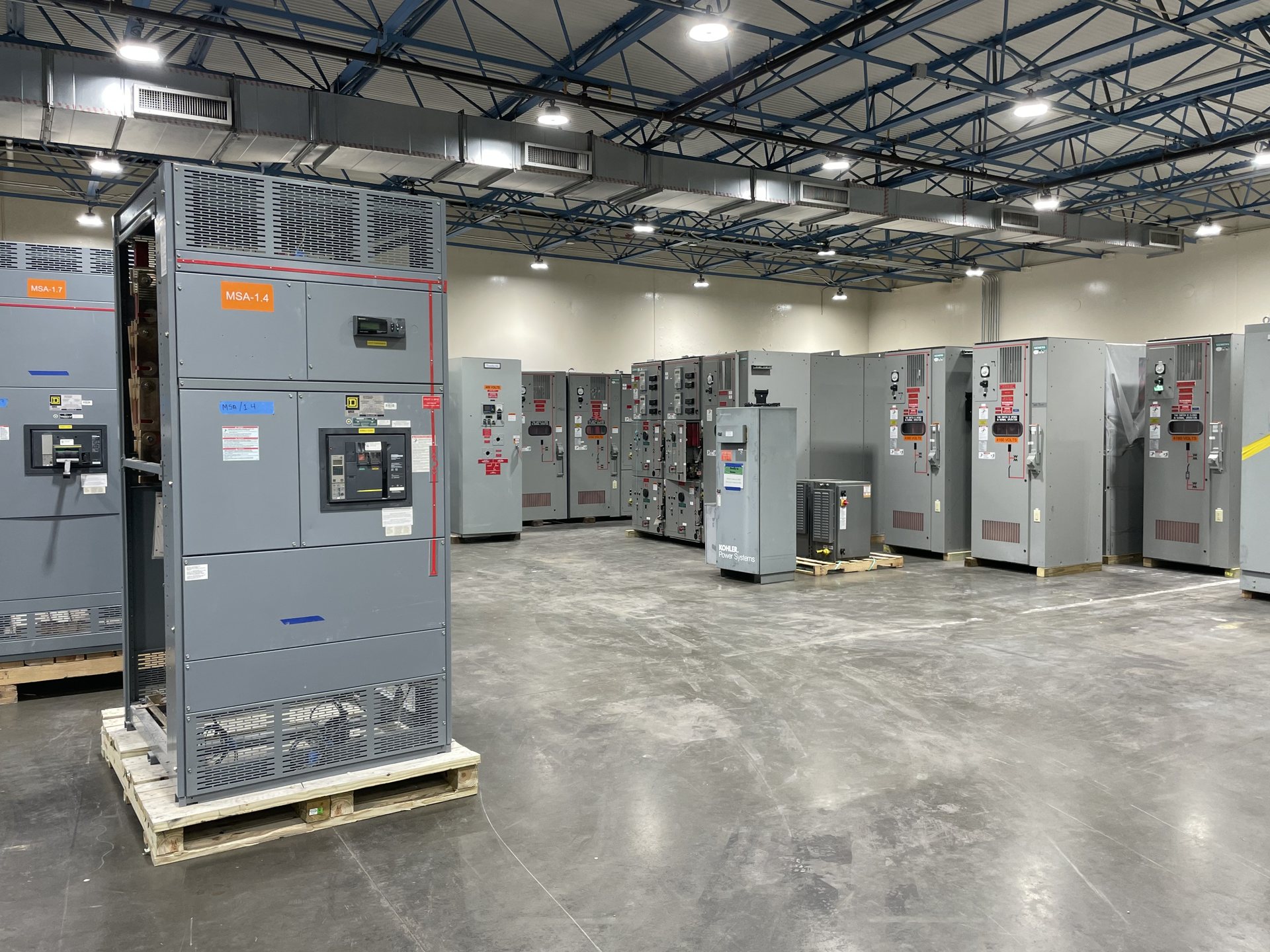
A decommissioned data center may leave electrical equipment distributed across rooms, with complete assemblies beside loose devices, accessories, and parts whose purpose is unclear. A useful inventory separates what can be identified from what remains uncertain. Record visible labels, configuration, dimensions, and access conditions so Louisiana Switchgear Buyer can assess the actual equipment and make an informed offer decision.
Separate complete assemblies from loose inventory
Start the inventory by grouping equipment according to how it is physically presented, not by assuming every item belongs to a nearby assembly. List switchboards, automatic transfer switch (ATS) units, power distribution units (PDUs), busway sections, and breaker equipment separately. Note whether each appears to be a complete assembly, a partial assembly, or an individual device or accessory. For loose items, record quantities and any readable markings, but do not assign them to a lineup unless that relationship is evident. This distinction helps prevent an incomplete section or unrelated spare from being represented as a complete operating assembly.
Build a room-by-room equipment record
Use a consistent location reference for each item, such as a room name, area designation, or position within a row. Give every photographed assembly or group a matching inventory identifier, and keep that identifier consistent across notes, images, and device lists. Where one room contains several kinds of distribution equipment, record each type separately rather than combining it under a general label such as electrical gear. A room-by-room record makes mixed inventory easier to review and helps clarify whether equipment is together, separated, or spread across different access points without claiming that proximity proves a system connection.
Capture visible identification and ratings
Photograph nameplates and other visible labels where they can be recorded safely without opening energized compartments or touching equipment. Note the manufacturer, model or catalog number, serial number, voltage, current rating, phase, frequency, and interrupting rating when each is legible and relevant to the item. Mark unreadable, obscured, or missing information as unknown rather than estimating it from neighboring gear. For breakers and other removable devices, record markings on the device itself as well as any visible position or designation associated with it. Identification details support assessment; they do not establish operating condition or test history.
Use schedules and diagrams as supporting records
Include a one-line diagram or section schedule when available, and identify the document as a reference rather than treating it as proof that the installed inventory matches the drawing. Note the document title, revision or date if shown, and the rooms or equipment it appears to cover. Compare listed sections with visible labels and record mismatches, missing pages, or equipment that cannot be matched. A device list can add detail for breakers, ATS units, PDUs, and accessories, but distinguish documented descriptions from observations made during the inventory. This preserves useful context while leaving unresolved relationships clearly identified.
Describe dimensions and access constraints
Record approximate dimensions only when they can be obtained without disturbing equipment, and identify whether a measurement applies to a full assembly, a section, or a loose item. Describe access conditions that affect review or removal: doorway or route restrictions, stairs, overhead obstructions, equipment position, and whether loading access is apparent. Photos of the route can help explain constraints, provided they do not require unsafe entry or contact with electrical gear. Do not move, disconnect, dismantle, or prepare equipment for lifting. Qualified professionals must handle electrical isolation, rigging, lifting, and removal; the seller should report constraints rather than perform that work.
Keep unknowns and authorization explicit
Create a short unknowns list alongside the equipment record. It may include uncertain assembly boundaries, missing ratings, unclear device-to-section relationships, or inaccessible labels. Separately document ownership or authorization status and identify who can confirm permission to sell the assets. Do not infer ownership from facility access, equipment location, or an old inventory sheet. Clear authorization information helps establish whether a transaction can proceed, while a candid account of unknowns lets an assessor distinguish verified details from assumptions. No seller testing is required for review, and a listing or photograph should not describe equipment as operational unless that condition is established.
Prepare the inventory for an assessment
Send the room-based device list, available schedules, nameplate photographs, assembly images, dimensions, access notes, and ownership or authorization information together. Identify which items are complete assemblies and which are loose, partial, or uncertain, and flag anything that may be obstructed or difficult to reach. Louisiana Switchgear Buyer assesses equipment before making an offer; acceptance is not guaranteed. If a transaction is agreed, the buyer handles and pays for qualified disconnects, crane and rigging work, loading, freight, and hauling. Keep the equipment undisturbed until removal is coordinated by qualified professionals, and share any newly discovered identification or access detail before the assessment.
Buyer notes
Send the facts that move the review forward.
Include the nameplate, lineup or device photos, approximate quantity, visible condition and where the equipment is located. We buy equipment; we do not sell replacement gear or represent a test result that has not been provided.
Start with the nameplate
Request a quote
Tell us what you have. We buy switchgear from decommissioned data centers, shut-down power plants and other facilities. Crane, rigging, disconnects, loading, freight and hauling are on us. You do nothing but get paid.