When a generating facility is retired, equipment records can help distinguish a complete assembly from loose devices and identify what may merit a buyer’s review. Nameplate capture is one useful part of that record, alongside existing schedules, photos, dimensions, access information and ownership authorization. Share only information already available or safely observable; qualified professionals handle isolation, disconnection, lifting and removal.
Start with the existing equipment record
Gather available one-lines, switchgear section schedules, equipment lists and decommissioning inventories before describing the lot. These records can connect a lineup or auxiliary system to its documented role without requiring assumptions about its former service. Note the document date and any known revisions, and flag gaps rather than filling them from memory. A buyer can use the records to understand how listed sections relate, compare the paper inventory with visible equipment and identify questions for follow-up. If records are incomplete, a partial set is still useful when its limits are clearly stated.
Capture visible nameplate information safely
Use existing photographs or images taken from a safe exterior position to record manufacturer, model or type, serial number, voltage, current, interrupting or other marked ratings, and date information where visible. Include the full plate in focus, plus a wider view showing which assembly it belongs to. Do not open an energized compartment, remove covers, approach exposed conductors or handle equipment to improve a photograph. If a plate cannot be read from a safe location, mark the field as unreadable or unknown. The buyer can assess legibility and compare visible markings with the equipment list.
Separate complete assemblies from loose items
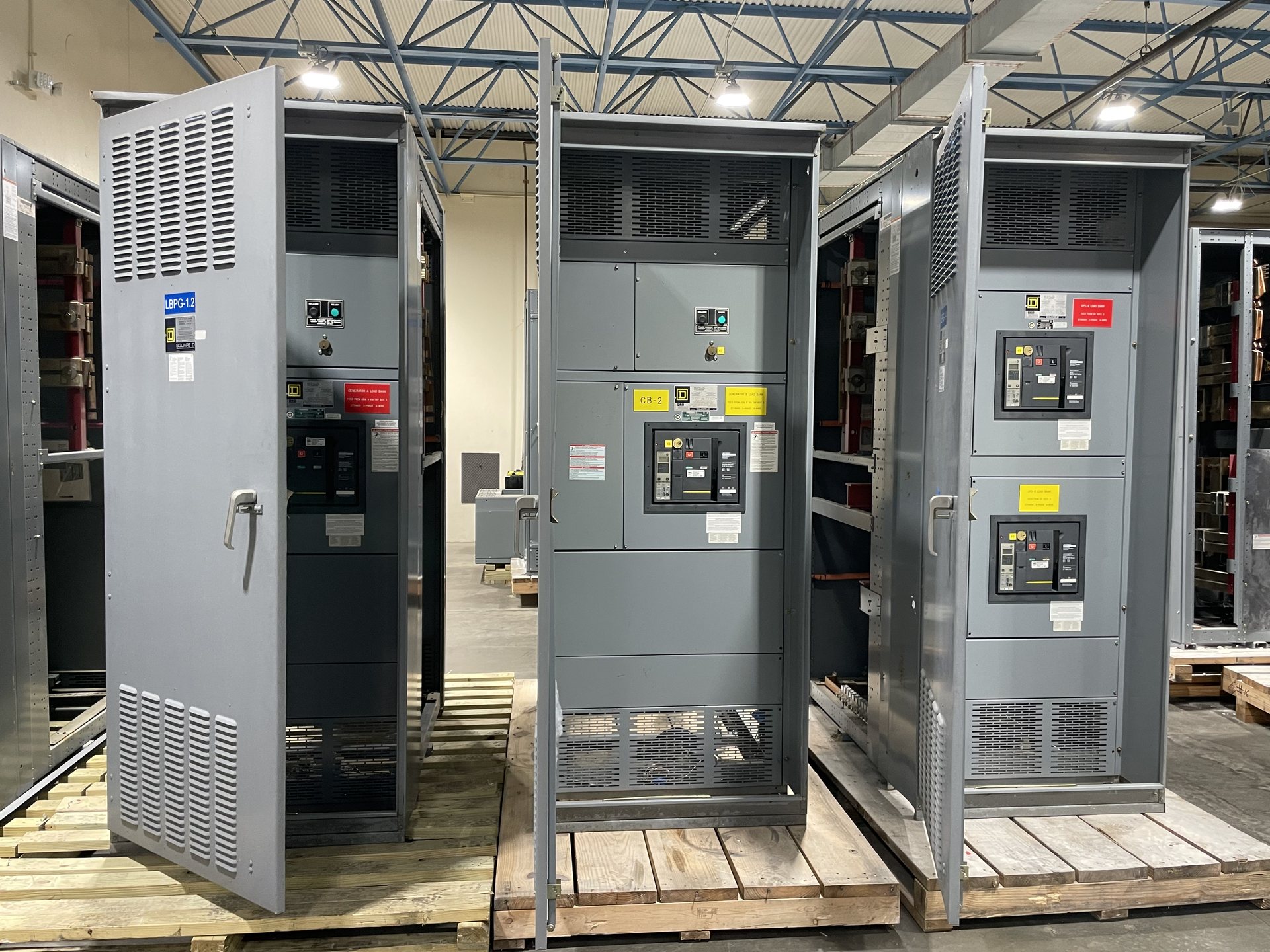
Describe what appears to be a complete switchgear lineup, station-service assembly, MCC section or auxiliary panel, and identify any devices or accessories recorded separately. For each group, state whether components are installed, stored loose, or listed in records but not located. Include breaker types and quantities only when supported by visible markings or an existing device list. Avoid calling an assembly complete merely because its exterior is present. This distinction helps a buyer consider whether equipment can be reviewed as a coordinated lot, as individual assemblies or as separate components, subject to assessment.
Record breakers, MCCs and auxiliary equipment distinctly
For breakers, note visible identifiers and ratings, the associated lineup or section if known, and whether the records show them installed or loose. For MCCs, auxiliary panels and control equipment, record section labels, marked ratings and any documented relationship to station-service systems. Keep control equipment separate in the inventory when its purpose or compatibility is uncertain. A device list can help reconcile quantities against the schedule, but do not infer interchangeability from appearance. Buyers use these distinctions to understand the scope and organization of the equipment, while the assessment determines whether any item is suitable for an offer.
Add dimensions and exterior photographs
Provide approximate overall dimensions for each assembly or group when those measurements already exist in records or can be obtained safely without touching equipment. Identify the measurement source and units, and distinguish a single section from a complete lineup. Exterior photographs can show arrangement, labels and visible condition; include context images as well as readable close-ups of markings. Do not enter restricted areas or position yourself near hazards to capture an image. These details help a buyer consider handling, transport and lot configuration. They do not establish internal condition or prove that equipment has been tested.
State what remains unknown
Use an explicit unknowns list for missing nameplates, unreadable ratings, uncertain accessory counts, undocumented modifications or discrepancies between schedules and visible labels. Note whether the information is absent from the records or simply not visible in existing images. Do not estimate a rating from the equipment’s size or assign a device to a section without support. Clear uncertainty lets a buyer focus follow-up questions and avoid treating an assumption as a fact. No seller testing is required for a review; equipment condition and identity are assessed before an offer, and an offer is not guaranteed.
Include access and authorization details
Alongside the inventory, note the site’s available access information, known handling constraints, and who can confirm ownership or authorization to transfer the equipment. Include relevant loading-area or removal-access details from existing plans or records, without attempting to prepare equipment yourself. Louisiana Switchgear Buyer purchases used, surplus and decommissioned electrical equipment, including gear from shut-down power plants. On an agreed transaction, it handles and pays for qualified disconnects, rigging, loading, freight and hauling; qualified professionals perform electrical and lifting work. A cash offer and upfront payment are available on agreed transactions, following equipment review.
Buyer notes
Send the facts that move the review forward.
Include the nameplate, lineup or device photos, approximate quantity, visible condition and where the equipment is located. We buy equipment; we do not sell replacement gear or represent a test result that has not been provided.
Start with the nameplate
Request a quote
Tell us what you have. We buy switchgear from decommissioned data centers, shut-down power plants and other facilities. Crane, rigging, disconnects, loading, freight and hauling are on us. You do nothing but get paid.