Decommissioned data-center electrical equipment often reaches review with gaps in its history: labels may be obscured, accessories separated, or field connections no longer documented. A useful inventory distinguishes what can be identified from what remains uncertain. Louisiana Switchgear Buyer reviews used, surplus, and decommissioned distribution equipment—including switchboards, ATS units, busway, PDUs, breakers, and related assemblies—using the available records and safe, accessible observations.
Separate assemblies from loose components
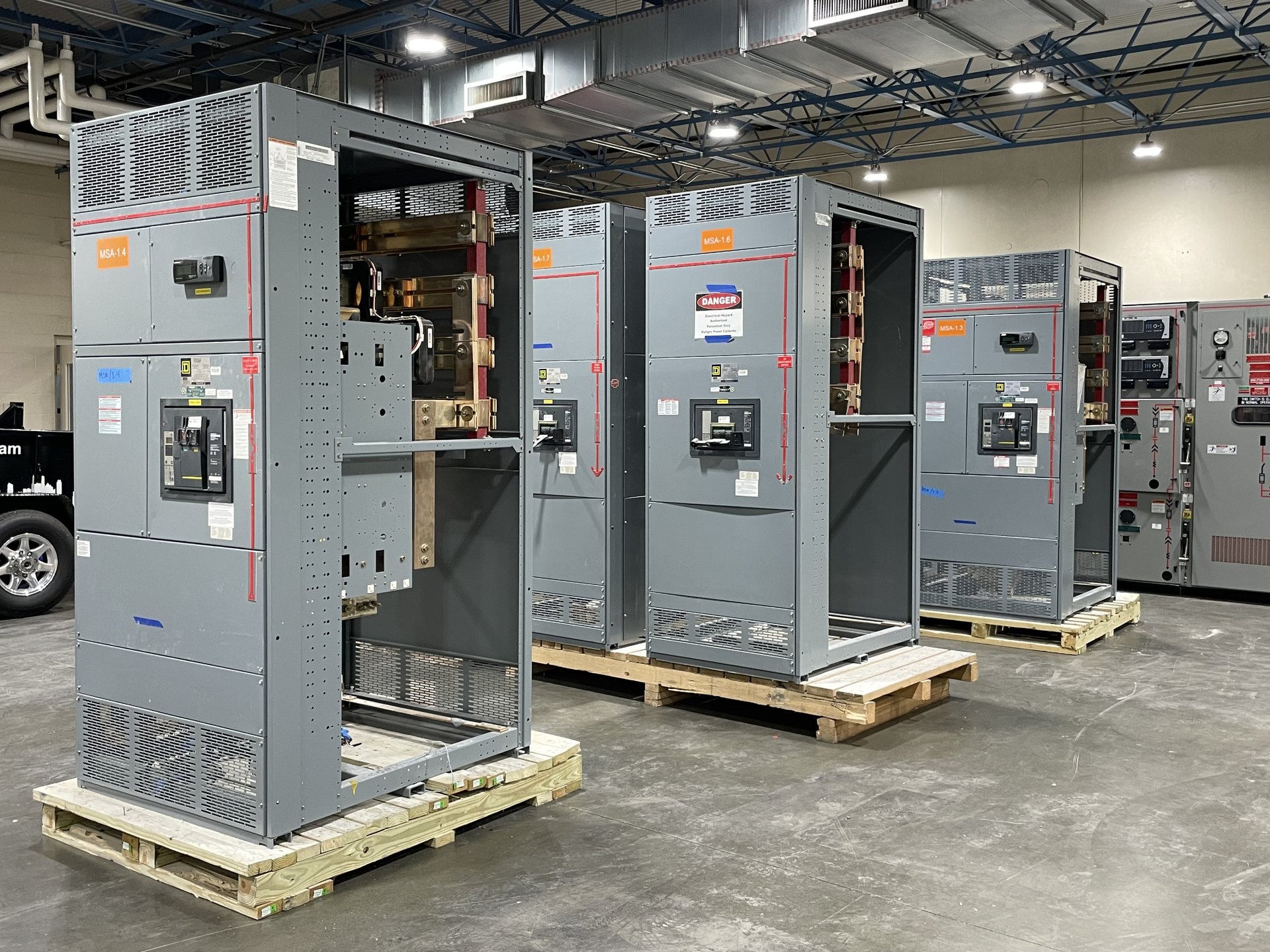
Start by listing complete-looking assemblies separately from devices, spares, and accessories stored nearby. A switchboard section with its enclosure, doors, and visible breakers is different from a group of loose breakers whose original positions are unknown. Likewise, an ATS may be a complete unit, while control components or bypass accessories may have been removed or set aside. Record these distinctions without assuming that nearby parts belong together. If a relationship is uncertain, mark it as unconfirmed. This prevents a buyer from treating a mixed lot as a complete lineup or valuing loose items as installed equipment.
Capture identifiers without filling gaps
Record manufacturer, model, catalog or serial numbers, voltage, current, interrupting ratings, and other nameplate information where visible and legible. Photograph the full equipment face and each accessible nameplate so text can be reviewed later. Do not infer a rating from appearance, neighboring equipment, or a partial label. For breakers, note visible device identifiers and ratings; for busway, capture marked series and rating information on accessible sections. Missing or unreadable fields should remain explicitly unknown. Do not open energized compartments or remove covers to find labels; qualified personnel must determine whether any additional inspection is safe.
Use records to establish configuration
A one-line diagram or section schedule, when available, can clarify how assemblies were arranged and how equipment related to the data-center distribution system. Compare document identifiers with visible labels, but flag mismatches rather than resolving them by guesswork. A schedule may describe a lineup that was later modified, or a drawing may not reflect the final installation. For PDUs and switchboards, note the document reference and any apparent correspondence between the record and the equipment. If no drawings remain, say so. Partial documentation is still useful when its limits and date or revision, if shown, are recorded.
Describe unknowns as actionable questions
An unknown-field list helps focus review without turning uncertainty into a claim about condition. Examples include whether a breaker belongs to a particular section, whether an ATS includes its bypass arrangement, or whether busway fittings are included with the straight lengths. Distinguish “not visible,” “not documented,” and “identity uncertain”; these describe different gaps. Do not label equipment operational, tested, or complete unless supported by reliable records. Louisiana Switchgear Buyer assesses the available details before making an offer, and an offer is not guaranteed. Clear unknowns allow the review to identify what can be evaluated and what remains unresolved.
Photograph context as well as detail
Useful photographs show both individual identification and the surrounding lot. Take overview images from safe, permitted positions, then capture accessible labels, device faces, and loose-item groupings. Include a scale or dimensions only when they can be recorded without approaching hazards or interfering with equipment. Avoid images that conceal missing doors, separated components, or uncertain associations. A photo should document what is visible, not suggest that internal parts have been examined. If access is restricted, note that fact instead of asking staff to enter a restricted area or manipulate equipment for a better view.
Record dimensions, access, and authorization
Dimensions help distinguish similar assemblies and plan a review, particularly when sections, ATS units, or PDU enclosures have been separated. Record approximate height, width, depth, and the number of sections only when measurements can be taken safely by appropriate personnel. Describe access constraints such as limited staging space, restricted entry, or equipment still in place; these affect removal planning. Also establish who owns the equipment or is authorized to arrange its sale. Do not disconnect, lift, or prepare electrical gear yourself. Qualified professionals handle isolation and removal, while Louisiana Switchgear Buyer handles and pays for qualified disconnects, rigging, loading, freight, and hauling on agreed transactions.
Build a review-ready lot schedule
Bring the information together in a device list with quantity, assembly status, visible identifiers, marked ratings, dimensions, photo references, and open questions. Group equipment by type and location within the lot, while keeping unassociated components separate. Include available one-lines or schedules, access notes, and ownership or authorization status. Testing by the seller is not required; do not represent unverified equipment as tested or functioning. Louisiana Switchgear Buyer considers used, surplus, and decommissioned equipment across voltage classes, including gear from shut-down data centers and power plants. It can make a cash offer and pay upfront on agreed transactions after review and acceptance.
Buyer notes
Send the facts that move the review forward.
Include the nameplate, lineup or device photos, approximate quantity, visible condition and where the equipment is located. We buy equipment; we do not sell replacement gear or represent a test result that has not been provided.
Start with the nameplate
Request a quote
Tell us what you have. We buy switchgear from decommissioned data centers, shut-down power plants and other facilities. Crane, rigging, disconnects, loading, freight and hauling are on us. You do nothing but get paid.