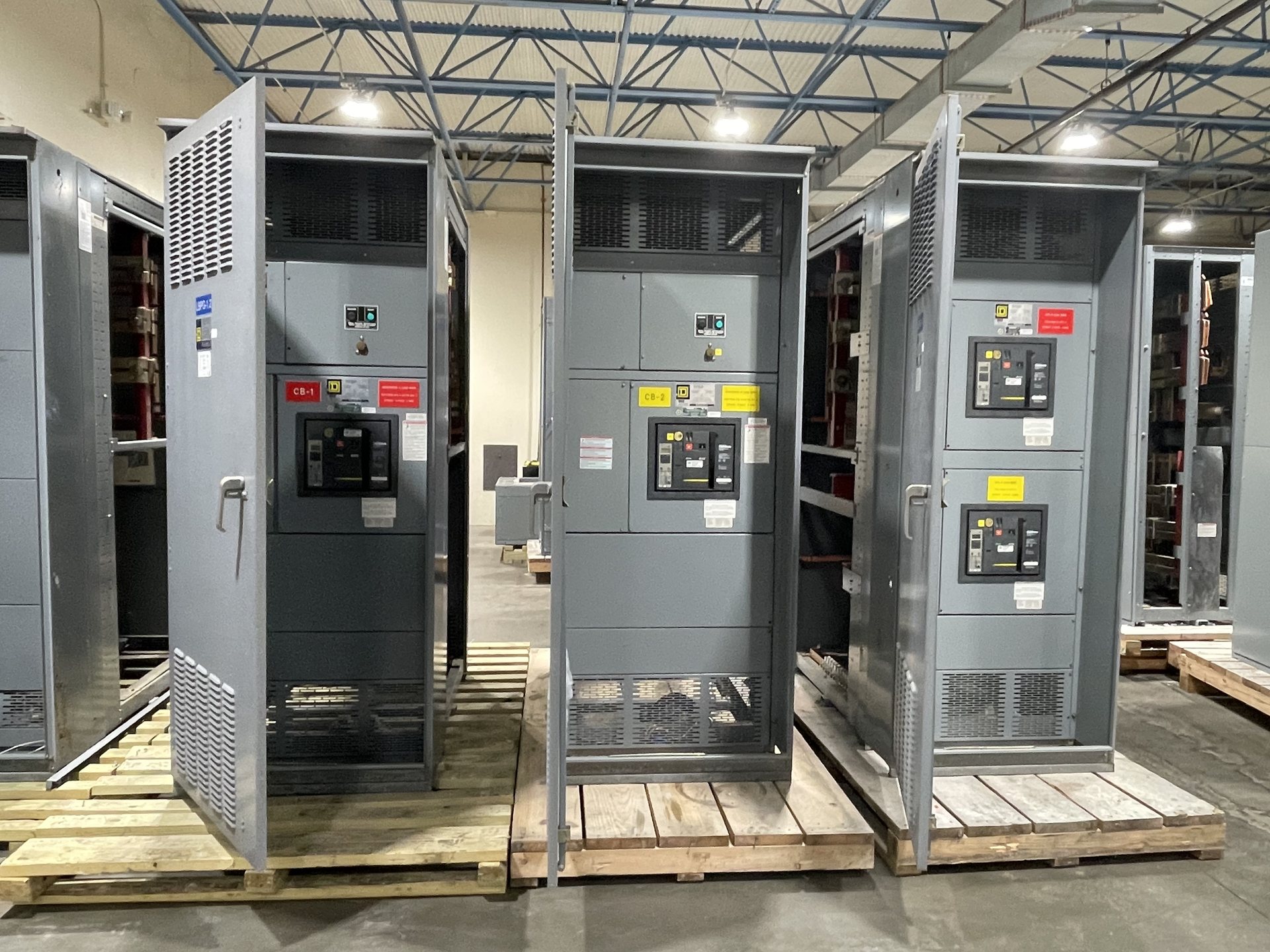
An industrial closure can leave complete distribution assemblies beside loose breakers, operators, trip units, and other devices. Sorting those items clearly helps Louisiana Switchgear Buyer assess what is included without treating an unidentified component as a complete assembly. Record what is visibly present, distinguish confirmed details from unknowns, and gather available documents before requesting review. The equipment remains subject to assessment; an offer is not guaranteed.
Separate complete assemblies from loose devices
Start the lot inventory by listing complete equipment separately from individual components. A motor control center section, switchboard lineup, panelboard, busway run, or utility-area assembly belongs on the assembly list only when its scope is identifiable. Record loose breakers, relays, trip units, operators, control devices, and accessories as separate items, noting any apparent association with an assembly. Do not assume a loose device was installed in a particular section merely because it is nearby. This distinction gives the buyer a clearer picture of the lot and helps prevent component counts from being mistaken for complete equipment.
Describe what is visibly marked
For each assembly and loose device, transcribe identifiers and ratings that can be read from accessible labels or nameplates: manufacturer, catalog or model number, voltage, current, interrupting rating, and serial or type information where shown. Mark fields as unreadable or not visible rather than filling gaps from memory or a nearby item. A device’s visible rating does not establish that it is suitable for a particular assembly or that it is operational. Do not open energized compartments or handle electrical equipment to obtain details. Qualified personnel should manage any inspection requiring access or electrical isolation.
Use a device list that preserves relationships
Give each loose item a simple inventory identifier and describe its visible form, markings, and quantity. If an item is clearly associated with a lineup or section, record the basis for that link, such as a matching label or documented schedule; otherwise mark the relationship unknown. Keep complete assemblies, installed devices, and loose spares in distinct categories. Note whether accessories are present, but avoid describing a set as complete unless the included parts are known. This format helps reviewers distinguish a breaker supplied with a section from an extra breaker found elsewhere in the closure lot.
Gather documents and photographs safely
Useful records include a one-line diagram or section schedule when available, nameplate information, a device list, overall and detail photographs, approximate dimensions, access notes, and confirmation of ownership or authority to sell. Photographs should show equipment from safe, accessible viewpoints and should not require anyone to remove covers or approach exposed electrical parts. Identify which documents correspond to which assembly or inventory number. If drawings are missing, outdated, or inconsistent with visible labels, say so. The purpose is to support review, not to certify configuration, condition, or compatibility.
Make uncertainty explicit
A closure inventory may leave important questions unanswered: whether a lineup is complete, whether a loose device belongs to it, whether internal components remain, or whether dimensions and ratings have been confirmed. List these as open items rather than inferring answers from appearance. Note unreadable labels, missing schedules, unknown quantities, and any limits on access. State whether equipment condition is unknown; no seller testing is required for review. Clear uncertainty helps the buyer assess the available information and decide whether more documentation is useful before making an offer.
Account for access, ownership, and scope
Before review, clarify which equipment is included, where it is located within the facility, how it can be reached, and whether removal access is restricted. Provide approximate dimensions where known and flag narrow routes, elevated placement, or other access considerations without attempting to plan a lift. Confirm that you own the equipment or are authorized to arrange its sale, and identify any excluded items or building systems that must remain. These details help define the proposed lot and removal scope; they do not replace a site assessment or qualified planning.
Coordinate assessment and recovery
Submit the inventory and supporting records for assessment; acceptance is not guaranteed, and an offer depends on review of the equipment and lot details. Louisiana Switchgear Buyer considers used, surplus, and decommissioned switchgear across voltage classes, including equipment from industrial closures. On an agreed transaction, payment is made upfront. The buyer coordinates and pays for qualified disconnects, crane and rigging work, loading, freight, and hauling. Sellers should not disconnect, dismantle, lift, or load electrical equipment. Electrical isolation and all removal work must be handled by qualified professionals.
Buyer notes
Send the facts that move the review forward.
Include the nameplate, lineup or device photos, approximate quantity, visible condition and where the equipment is located. We buy equipment; we do not sell replacement gear or represent a test result that has not been provided.
Start with the nameplate
Request a quote
Tell us what you have. We buy switchgear from decommissioned data centers, shut-down power plants and other facilities. Crane, rigging, disconnects, loading, freight and hauling are on us. You do nothing but get paid.