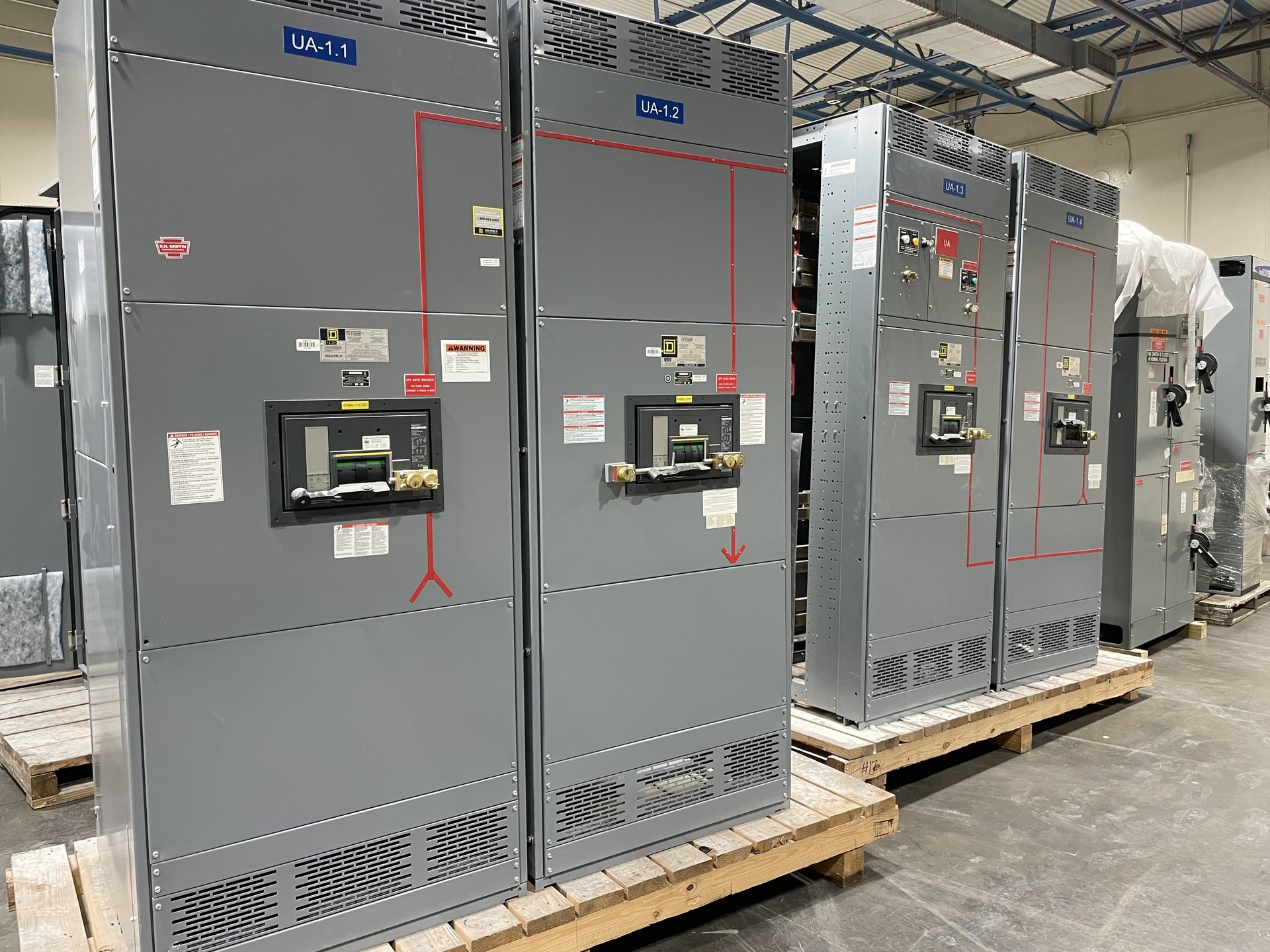
When an industrial plant closes, a useful equipment inventory begins with visible identifiers—not assumptions about what a lineup once served or whether it remains functional. Capture nameplates, assembly boundaries, loose devices, dimensions, and access conditions across process distribution, MCCs, switchboards, panels, busway, breakers, and utility-area assemblies. This record helps distinguish complete equipment from partial lots and gives a buyer facts to assess before making an offer.
Start with assembly boundaries
List each apparent assembly as a separate inventory line: for example, a switchboard section, MCC lineup, panel, busway run, breaker, or utility-area assembly. Record what appears to belong together and what is detached or stored separately. Note whether doors, covers, internal devices, and visible accessories are present, without opening energized compartments or handling equipment. A lineup that looks continuous may include distinct sections, while nearby loose devices may not belong to it. Clear boundaries help a buyer assess completeness and avoid treating a mixed plant-closure lot as one uniform asset.
Capture nameplates and visible ratings
Photograph each accessible nameplate squarely and legibly, then transcribe the manufacturer, catalog or type designation, serial number, voltage, current, interrupting rating, and other marked ratings where shown. Record the location of each plate—such as a door, section, or device—so identifiers can be matched to the correct item. Do not infer a rating from neighboring equipment or a former process use. If a marking is obscured, damaged, or unreadable from a safe position, note that limitation as unknown. Nameplate information supports identification; it does not establish present operating condition or test status.
Separate installed devices from loose items
Create a device list for breakers, trip units, control components, and accessories that are visibly installed or separately stored. For each loose item, record its markings and approximate quantity, and identify the container or area where it was found. Keep the distinction between “installed,” “loose,” and “association unknown”; a breaker beside a lineup is not necessarily a matching spare. Do not remove devices to improve the inventory. Where the equipment cannot be inspected safely, leave its internal contents and condition unverified and let qualified personnel manage any access or isolation needed.
Record documents, dimensions, and unknowns
Gather an available one-line diagram or section schedule, photographs, device list, dimensions, access notes, and documentation of ownership or authorization to sell. Mark which records are current, incomplete, or of uncertain relevance rather than presenting them as definitive. Measure only where this can be done without approaching hazards or interfering with equipment; otherwise, label dimensions as approximate or unavailable. Note missing nameplates, unclear section order, unconfirmed device associations, and unknown condition explicitly. A short, honest list of gaps is more useful than filling them with assumptions drawn from the plant’s previous configuration.
Describe the lot and removal access
For a practical review, organize the inventory by area and assembly, then connect each entry to its photographs and supporting documents. Identify whether the proposed sale covers the whole lot or selected items, and flag anything excluded or with uncertain ownership or authorization. Describe access facts visible to the seller: building level, doorway or aisle constraints, loading area, and known lifting restrictions, without attempting a lift plan. Qualified professionals must assess electrical isolation, disconnection, rigging, and lifting. These details help determine whether the equipment can be evaluated as a saleable lot and what handling coordination may be required.
Request an assessment before committing
Submit the inventory and available records for review before treating any item as accepted for purchase. Assessment may consider equipment type, visible identification, completeness, documentation, and removal requirements; an offer is not automatic, and acceptance is not guaranteed. No seller testing is required. Do not represent equipment as operational or tested unless that status is supported by appropriate records. If the buyer makes an offer and you accept the agreed transaction, payment is made upfront. Confirm the items covered, exclusions, and handling arrangements in the transaction terms so the agreed scope is clear.
Coordinate recovery through qualified crews
Once a transaction is agreed, the buyer handles and pays for qualified disconnection, rigging, loading, freight, and hauling. Do not attempt to disconnect, move, dismantle, or prepare electrical equipment for lifting yourself; work involving electricity, isolation, or heavy loads belongs to qualified professionals. Keep the inventory, nameplate photographs, and access notes available to support coordination, and identify any changes to the lot or access since review. This sequence preserves a clear record from identification through recovery while allowing the seller to focus on confirming authority, sale scope, and the agreed arrangements.
Buyer notes
Send the facts that move the review forward.
Include the nameplate, lineup or device photos, approximate quantity, visible condition and where the equipment is located. We buy equipment; we do not sell replacement gear or represent a test result that has not been provided.
Start with the nameplate
Request a quote
Tell us what you have. We buy switchgear from decommissioned data centers, shut-down power plants and other facilities. Crane, rigging, disconnects, loading, freight and hauling are on us. You do nothing but get paid.