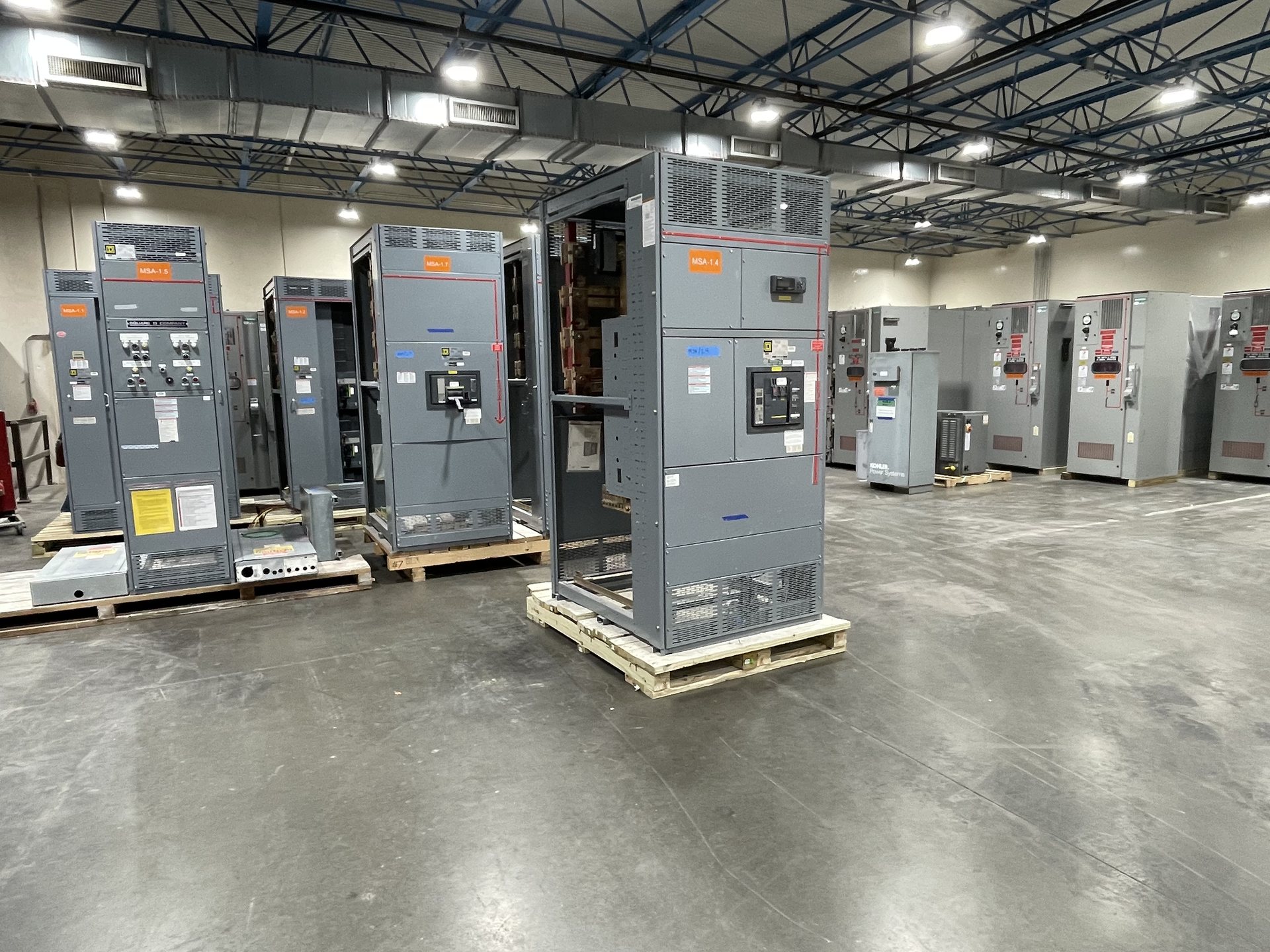
Shipping splits determine how a switchgear lineup can be handled, loaded, and transported—not just how it looks on a floor plan. When you are considering a sale, useful split information helps us assess the complete lot and plan removal around the actual sections, access, and loading conditions. Share what is documented; qualified professionals will review and coordinate the physical work.
Describe the lineup as it is arranged
Start with the equipment’s present configuration: identify the lineup or assembly, its approximate section count, and which pieces appear to be separate shipping splits. A switchboard may consist of several connected sections, while an MCC may include a long lineup with a distinct shipping break. A unit substation can involve separate transformer-connected and switchgear components. These distinctions affect handling and valuation. If the original arrangement is uncertain, say so rather than treating every visible seam as a confirmed split. Photos and available drawings can help us compare the documented arrangement with what is present.
Separate documented dimensions from estimates
For each split, provide approximate dimensions only when they are documented or clearly identified as estimates. Dimensions of one section should not be substituted for the complete lineup, and a cabinet’s exterior measurements do not necessarily describe attached transition pieces or accessories. Likewise, report approximate weight only when a record, nameplate, drawing, or other reliable source supports it. Do not estimate by lifting, moving, or opening equipment. If dimensions or weights are unavailable, note that plainly; our review can take the gap into account before an offer and removal plan are considered.
Treat lifting-point information cautiously
A drawing or equipment document may show lifting points for a particular section or split. Pass along that information with its source and indicate which section it appears to cover. Do not assume similar-looking sections share the same lifting arrangement, or that a marked point is usable in the equipment’s current condition. If no lifting details are documented, leave them unknown. Qualified rigging professionals must assess the actual equipment and determine suitable handling methods. Sellers should not attach lifting gear, test a point, or attempt to reposition a section to clarify its configuration.
Explain how the load can be reached
Describe the route and loading surface in practical terms: whether equipment is on a dock or at ground level, where a vehicle could approach, and whether the surface or access path has known restrictions. Note tight turns, overhead limitations, stairs, narrow openings, or other obstacles only as information you can safely observe without entering hazardous areas. Conditions can differ between a dock-loaded switchboard and ground-level MCC sections, even when the equipment itself is comparable. This context helps us determine what further review and qualified handling arrangements may be needed.
Keep loose items matched to the right split
List loose breakers, accessories, and related components separately from the main sections, and identify any documented association with a lineup or shipping split. A breaker removed from a switchboard should not be represented as installed or matched unless that is established. Busway and transformer-connected assemblies also merit clear descriptions of which pieces are included and how they relate to the larger equipment. An inventory can distinguish included items from items that are absent or uncertain. Keep loose components where they are safely staged; we can coordinate handling and loading as part of an agreed transaction.
Record restrictions and staging information
Share known limits on access, working hours, site entry, vehicle movement, or available staging space, along with any required coordination contact. Describe whether sections are already grouped or staged, but do not rearrange them to make the lot easier to review. If equipment is in a decommissioned plant or data center, the same practical questions apply: what is included, how it is split, and what restrictions govern access and removal. Qualified professionals handle isolation, disconnects, rigging, lifting, loading, and hauling; you do not need to perform that work.
Use the information for a realistic review
A complete picture of shipping splits helps us assess the equipment before making a cash offer, but it does not guarantee acceptance. We buy used, surplus, and decommissioned switchgear across voltage classes and can consider switchboards, MCCs, unit substations, busway, and related components. No seller testing is required. If we agree on a transaction, we pay upfront under the agreed terms and handle and pay for qualified disconnects, crane and rigging work, loading, freight, and hauling. Clear split records help align the review with the actual lot and its removal requirements.
Buyer notes
Send the facts that move the review forward.
Include the nameplate, lineup or device photos, approximate quantity, visible condition and where the equipment is located. We buy equipment; we do not sell replacement gear or represent a test result that has not been provided.
Start with the nameplate
Request a quote
Tell us what you have. We buy switchgear from decommissioned data centers, shut-down power plants and other facilities. Crane, rigging, disconnects, loading, freight and hauling are on us. You do nothing but get paid.