A staging area can shape the recovery plan as much as the equipment itself. Before a decommissioned switchgear lineup, switchboards, MCCs, busway or related assemblies are assessed, document where items are staged, how they are divided, and what loading access is available. Clear information helps qualified professionals evaluate handling needs and lets us consider the equipment for a purchase offer.
Map the staging area without entering hazards
Describe the staging area using information you can gather safely: its general location within the property, whether equipment is indoors or outdoors, and whether items are grouped together or dispersed. Photographs from a safe, authorized position can clarify these details. Do not approach energized equipment or enter restricted areas to obtain images. If the electrical status or isolation state is uncertain, leave it for qualified personnel to determine. A useful overview helps distinguish the equipment footprint from nearby stored material and identifies questions to resolve before a recovery plan is developed.
Record the equipment and its divisions
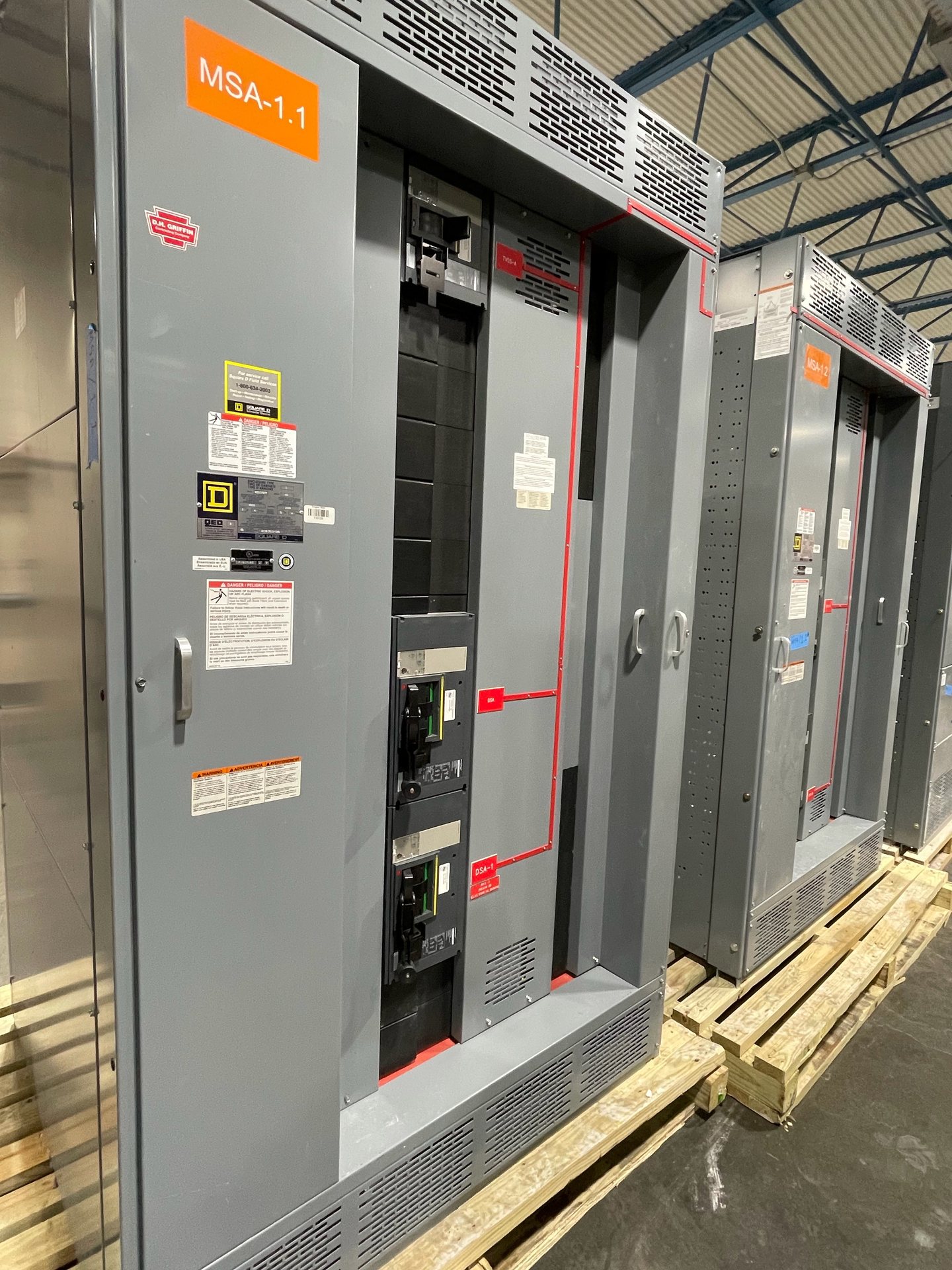
List each equipment category and, where visible, the quantity or lineup arrangement: switchgear sections, switchboards, MCC sections, unit substations, busway runs, transformer-connected assemblies, loose breakers and accessories. Note section counts and any known shipping splits rather than assuming a long lineup is one lift or one shipment. Keep labels and nameplate details in photographs when they can be captured safely. These records support an initial assessment, but do not establish operational condition or confirm that components are complete. The equipment is reviewed before an offer is made, and acceptance is not guaranteed.
Use dimensions and weights only when documented
Approximate dimensions and weight can help evaluate staging and transport, but record them only when supported by existing documentation or a reliable, qualified source. Identify which figure applies to a single section, a complete assembly, or a shipping split. Avoid estimating from appearance or moving equipment to obtain measurements. If weight is unknown, say so; that is more useful than an unsupported number. Visible lifting points may also be noted if their purpose is documented, but do not treat them as proof of capacity or suitability. Qualified professionals determine handling requirements.
Describe loading surface and access
Explain the route from the staging position to the anticipated loading area in practical terms: doorways, turns, ramps, thresholds, overhead constraints, and whether the surface is described as pavement, slab, gravel, or another material. Note dock or ground-level conditions, including any known difference in elevation or access limitation. Do not test a route by moving equipment or vehicles. Photos and site plans can help qualified logistics personnel review clearances and loading arrangements. If an access detail is unknown, flag it for later review rather than assuming machinery can reach the equipment.
Flag restrictions and site coordination needs
Include known restrictions that may affect access or scheduling, such as controlled entry, limited work hours, shared loading zones, escort requirements, or restrictions on vehicle size. State who can confirm access and whether other decommissioning work may overlap. Do not infer permissions from an open gate or an unused dock. Electrical disconnection, isolation, lifting, rigging, and loading must be handled by qualified professionals. We coordinate and pay for qualified disconnects and the removal logistics, including crane or rigging, loading, freight, and hauling on an agreed transaction; the seller should not perform this work.
Keep staging information tied to the listing
For an accurate equipment listing, connect each photograph and document to the relevant section or assembly. Identify loose breakers and accessories separately, and indicate whether busway or transformer-connected components are included in the described group. Note any known missing parts or uncertainty without labeling the equipment tested or operational. Equipment from decommissioned data centers and shut-down power plants is within our purchasing scope, as are surplus and removed assets across voltage classes. No seller testing is required. Clear records let us assess the equipment and logistics together before deciding whether to make a cash offer.
Prepare for review, not self-removal
Share the staging overview, available documentation, known access constraints, and a safe contact for site coordination. If an item is still connected, its status is unclear, or a route cannot be confirmed, record that as an open issue; do not attempt disconnection, repositioning, or lifting. After assessment and agreement, qualified professionals handle the removal and transport arrangements. Payment is made upfront on agreed transactions. This approach keeps the staging plan grounded in documented facts, avoids treating unknowns as assurances, and gives both sides a clearer basis for deciding whether the equipment and recovery logistics fit the transaction.
Buyer notes
Send the facts that move the review forward.
Include the nameplate, lineup or device photos, approximate quantity, visible condition and where the equipment is located. We buy equipment; we do not sell replacement gear or represent a test result that has not been provided.
Start with the nameplate
Request a quote
Tell us what you have. We buy switchgear from decommissioned data centers, shut-down power plants and other facilities. Crane, rigging, disconnects, loading, freight and hauling are on us. You do nothing but get paid.